Through its subsidiary Lyse Agon, the Stavanger-based energy group has developed a fast-charging hub for electric heavy-duty vehicles at Forus, one of the region’s major industrial and logistics areas. The facility features 16 charging points with a total installed capacity of 2.8 MW, supported by battery storage, AI-based energy management and a digital booking system.
The initiative also comes at a time when the EU is placing renewed emphasis on the decarbonisation of heavy-duty transport. In its 2027 Work Programme, published on 4 November 2026, the European Commission announced plans to review CO₂ emission standards for heavy-duty vehicles, seeking to advance climate neutrality while safeguarding the competitiveness of Europe’s automotive industry. As the transition progresses, innovative charging solutions such as Lyse Agon’s could help address one of the practical challenges of electrification: meeting growing electricity demand without placing unnecessary pressure on existing power grids.
Smarter charging and better grid utilisation
The initiative builds on experience from Elnett21, a demonstration project in the Stavanger region that explored how smart energy management and battery storage could facilitate transport electrification while making better use of existing electricity infrastructure.
One of the key innovations is a booking system that allows transport operators to reserve charging slots in advance. Approximately half of all charging sessions are already pre-booked, providing greater predictability for operators while helping the system anticipate electricity demand.
Booking information is integrated into an AI-supported battery management system, which considers expected charging demand, battery capacity, grid constraints and electricity market conditions to optimise energy use.
By coordinating charging demand with available battery capacity, the system aims to reduce pressure on the electricity grid during peak periods and improve the utilisation of existing infrastructure.
Lyse Agon is also developing AI-based tools for monitoring equipment, detecting faults, planning preventive maintenance and coordinating technicians, with the aim of making charging infrastructure more reliable and efficient.
Building on EU-Funded research
The technology also builds on knowledge gained through European research and innovation cooperation.
Through the EU-funded Horizon 2020 project INVADE, Lyse developed expertise in battery storage, energy management and electric vehicle charging. The project tested several applications, including peak shaving, battery storage and optimisation of locally generated solar energy.
According to Lyse, the knowledge gained through INVADE has been further developed and applied in the charging project at Forus.
This demonstrates how European research cooperation can contribute to building technological capabilities that later support practical innovation and commercial applications.
Lyse also participated in the EU-funded Triangulum smart cities project. While its results have not yet been incorporated into the Forus charging solution, the company sees potential for applying knowledge from the project in future developments, including recovering waste heat from liquid-cooled charging installations.
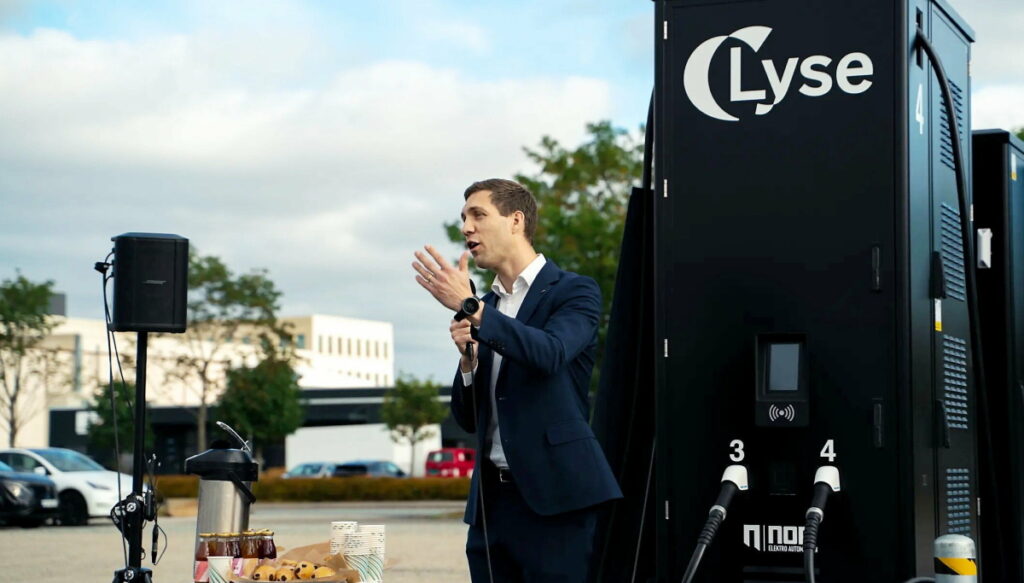
Norway’s Minister of Climate and Environment, Andreas Bjelland Eriksen, at the opening of the facility last year.
From public support to commercial opportunities
Public funding played an important role in the project’s initial development, helping establish the conditions for a commercially viable solution.
However, as the market for electric heavy transport expands, Lyse Agon expects similar projects to become easier to realise with less dependence on public support.
This development is particularly relevant as European transport operators and infrastructure providers seek scalable solutions for electrification without placing unnecessary demands on existing power grids.
Potential for international markets and maritime electrification
Lyse Agon is now exploring opportunities to apply the technology beyond heavy-duty road transport.
One area of interest is maritime electrification, where ports and vessels face similar challenges related to high electricity demand, grid capacity and the need for flexible energy management. The Stavanger region already has experience in this field, including the EU-funded development of MS Medstraum, the world’s first fully electric fast ferry, which began operating in 2022. Read more about the project in our previous article.
However, the company sees opportunities extending beyond transport, with potential applications in other sectors where high power demand and battery storage need to be managed efficiently.
“ As long as there is a need for power and batteries are involved, we believe the solution can be applied. While we are not yet ready to enter international markets ourselves, we are open to exploring a dialogue with potential partners who see opportunities for the solution.” says Bjørnar Michaelsen, Head of Sales at Lyse Agon.
For European regions facing growing demand for electrification, the Stavanger solution offers an example of how digital innovation, battery technology and intelligent energy management can help address infrastructure constraints.
The initiative also illustrates the value of connecting regional businesses with European research networks and potential partners, turning technological expertise developed through international cooperation into solutions with wider market potential.
About Lyse
Lyse is a Norwegian energy and telecom group headquartered in Stavanger, with a history spanning more than 100 years. The group employs approximately 2,400 people and has an annual turnover of NOK 27 billion (around EUR 2.6 billion). The business is divided into three areas: renewable energy (hydropower and power trading), telecom (fibre, mobile and TV) and infrastructure and circular energy (power grid, street lighting, biogas, district heating and electrification). Lyse Agon belongs to the latter.